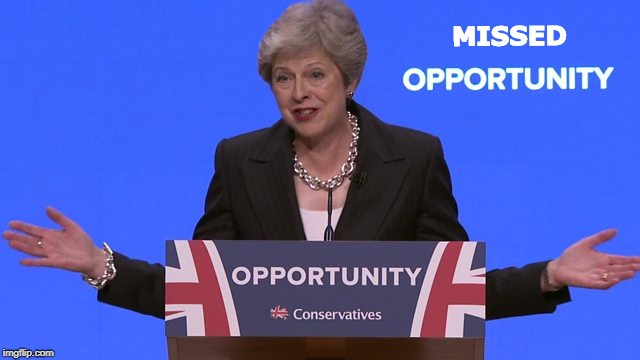
 A little later than intended, but a few final thoughts from me on Conservative Party Conference and where it leaves the Prime Minister, her Cabinet, and the membership in the context of what’s likely to be an increasingly antagonistic Autumn period as the business end of Article 50 negotiations unfolds.
Plenty of talent, plenty of views, but no grand vision for how Britain makes the most of Brexit
What was very striking for me on the fringe circuit was the extent to which rising star Ministers and MPs sought to signal in code their dissatisfaction at the lack of a focus on the ‘what comes next?’ essay question of how Britain thrives after Brexit.
There were good ideas floated about how a sovereign wealth fund could interplay with the UK’s international development strategy, and about the importance of the UK thinking longer-term about other global trading compacts it should target membership of.
There were great fringes run by CapX and Policy Exchange looking at big picture challenges for the economy like flagging trust in markets and fear of AI.
Chris Skidmore MP and George Freeman MP ran interesting sessions seeking insights from members on how we can thrive after Brexit.
But there seemed to be precious little ‘grand vision thinking’ in the main hall from the Chancellor, the Business Secretary and others on how the UK can really go up a gear after Brexit through reforms to its tax base, regulatory innovation, or fresh incentives to support inward investment and greater levels of endogenous business investment in productivity.
It feels like the party is still obsessing over the issue of ‘how we leave’ and the drama of leaving, and not paying enough attention to what we do once we leave.
In terms of where the serious political talent and grand vision could come from, I think we need leadership in the collective sense. It’s not just about picking the right party leader. We need more innovative thinkers and leaders of change who can communicate incisively and sell what will be at times controversial decisions to the public effectively.
We have that talent. There are plenty of Conservative Cabinet Ministers who aspire to be transformers rather than time servers – Penny Mordaunt, Dominic Raab, Michael Gove, Matthew Hancock, Sajid Javid, Esther McVey and Jeremy Hunt all stand out in this regard for me. Not all of them would be suitable options as a Prime Minister, but we need them to help collectively exercise leadership of bold, ambitious reform at a critical point in history for our country.
Still upright, but not stable
In overall terms, the Prime Minister did enough, with support from allies, to avoid major ructions at the conference itself.
The ‘precious vase’ of her Chequers Plan is as yet unbroken though increasingly wobbly. How realizable any deal she is able to clinch is in terms of the Parliamentary arithmetic is deeply open to debate.
The mood at the conference was split between those who could just about live with Chequers as a transitory compromise and those who believe it’s a gilded cage to remain trapped in perma-orbit around the EU in regulatory and economic strategy terms, with little real flexibility to strike trade deals or control immigration.
It’s hard to see Theresa May avoiding at least 20 ERGers voting against any final deal, and added to that the DUP feels deeply aggrieved by the UK Government’s negotiating stance on customs arrangements for Northern Ireland relative to the rest of the UK. Her path forward is deeply uncertain, and while she has weapons in her arsenal like Geoffery Cox to deploy to rally some of the party faithful behind a pragmatic approach, in the cold light of day there may simply not be the Parliamentary arithmetic for May to get a deal through in relation to trade, when you consider the dynamics in Labour in particular.
Just earlier that month, the Prime Minister seemed to get a new hearing from the membership when in the aftermath of a deeply testy Salzburg EU summit, she denounced the intransigence of the EU on a host of issues and made clear she wouldn’t be compelled to sign a deal that works for the EU economically but doesn’t work for the UK politically or economically.
She earned plaudits, but quickly scotched the good will by robustly ruling out any prospect of a Canada ++ style deal being the Government’s fallback negotiating position. In the face of the EU saying Chequers is essentially unworkable, this feels unwise.
Hello April, bye bye May?
If the Prime Minister’s to be taken at her word she wants to lead the party into another General Election in 2022, or beforehand if circumstances are favourable.
She’s a deeply unpopular figure with multiple schools of thought within the membership, and her premiership is also questioned within the Parliamentary Party.
If her challenge was to use the party conference to set out a compelling case to party members for why she should continue on as Prime Minister well beyond next Spring, I think her speech and the agenda outlined at this conference fell well short of the mark.
The general consensus is accurate in that she endeared herself to many with the dancing and delivered what at the surface is a functionally decent speech. It hit decent notes at points, but it failed to make a compelling case for why she must stay in the hot seat for our party to do well beyond March 31 2019.
There was no verve to it and precious little innovation in the offing. The most notable policy section related to a new National Cancer Strategy, which while welcome, is not something that would be exclusive to a May premiership. What modern British Conservative Prime Minister wouldn’t want to enhance the quality of cancer diagnosis and treatment given around half the populace are likely to suffer from the disease of cancer in their lifetime?
There was a lot of deeply familiar rhetorical positioning of the party as a bastion for opportunity, freedom and security that while well written didn’t exactly zing or give us a distinct answer to the essay question of “Why you, Theresa and not X/Y/ or Z?” Little new ground was trodden and there was no situational awareness of how ‘wet’ her agenda is now perceived to be by the majority of her members and many of her fellow MPs.
The paucity of narrative ambition shown with the single world conference theme – ‘opportunity’ – is ironically enough a missed opportunity for the Prime Minister. She lacks what President George H.W. Bush memorably termed “the vision thing” and the verve to sell that vision in a way that Conservatives can rally around.
That’s not to say she can’t go on, do a competent job, and potentially defeat Corbyn in a General Election. It’s plausible she could do that. But I suspect the party will push for extensive renewal in 2019.
 Daniel Cremin's Trove