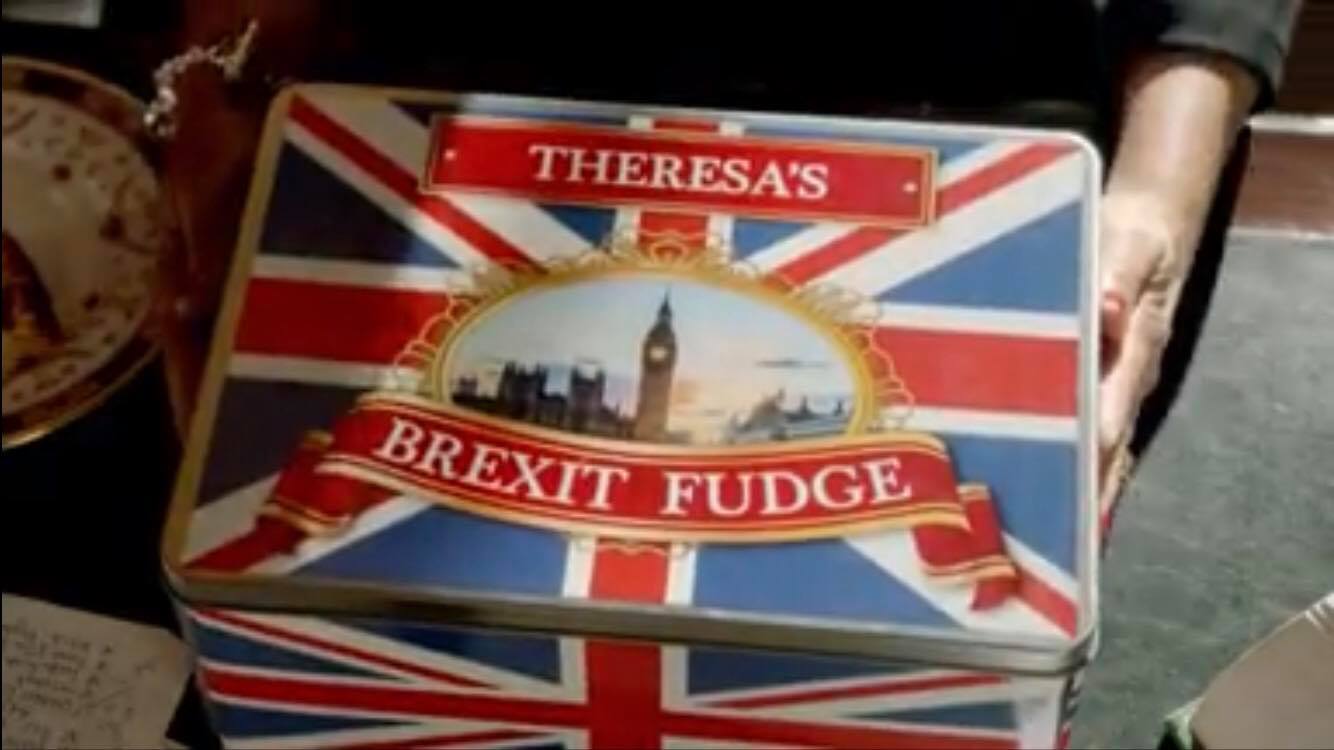
Compromise is not a dirty word Mrs May implored her colleagues and the country as she announced the end her short, yet at times seemingly interminable, premiership. Lecturing others on compromise is fairlyrich to begin with from a Prime Minister who excelled in being stubborn, prickly and imperious for much of her premiership.
Mrs May does, however, makes a valid point. Compromise, in the right spirit and context, is a perfectly acceptable notion in politics. But compromise can only function in a context where you have clear redlines in terms of your objectives, and are willing to show flexibility and good will beyond these redlines.
The truth is that after May gave up on her deadlines, she gave up on her redlines. As she at last, thankfully, discovered, you cannot compromise on sovereignty, democracy, and national self-respect simply to “getBrexit done”. Make no mistake she was prepared to legislate for a path toa permanent customs union and make Brexit conditional on a second referendum.
Few would doubt the sincerity of May’s emotional commitment to duty in the interest of public service. She did what she thought was right from the perspective of how she viewed the national interest best being served.
But however admirable that commitment to duty may be in theabstract, the hard reality is she chose in her final weeks to debase her office, and possibly doom her party, by seeking a squalid, arid compromise with a Labour Party led by an uneasy top team coalition of Marxists and Europhiles.
To anyone with an iota of realism, it was clear this wasnever going to be politically achievable or democratically legitimate in the minds of millions of Leave voters.
The result is she and her continuity-Remain allies in the Cabinet have now bungled the negotiations, broken the vow to leave at the endof March, and publicly endorsed the notion of legislating for a permanent customs union and a second referendum. They have fundamentally ruptured trust in the Conservative Party and, just as worryingly, the legitimacy of our two-party Westminster model system.
A neat compromise just isn’t possible now – if it ever was
There is a hard truth for Theresa May and her team here. When it comes to Brexit, the time for compromise was long before 29 March. There was rich scope to reset the approach to these negotiations by, for example, pursuing a more straightforward Canada style FTA outcome in terms of the UK-EU economic settings that could be enhanced over time.
The time to be reasonable and build consensus within either her party, or across the Parliament, was long before 29 March. This failureisn’t solely the responsibility of Mrs May and her aides, to be fair. This isan abject failure of the political class and many voters understandably view this as a national humiliation and an indictment of failing parties.
Some arch continuity-Remain advocates like Tobias Ellwood MP are doubling down on the “compromise at all costs” stratagem. Appearing on the BBC for the European Elections overnight on 26th and 27thMarch, Tobias actually advocated that the UK should approach any fresh renegotiations with the EU with “no redlines at all”.
Apparently, in Tobias’ mind it is perfectly acceptable forthe EU to have redlines such as a backstop without an end date, but not for the UK as we seek the fabled “good deal”.
It’s not just good sense that has been a casualty of this Mayite farce. The failure to keep our word and leave in an orderly manner on 29 March has inflicted real damage to the national psyche, the reputation of our democratic processes and institutions, and the tone of our public discourse. Forget the plummeting poll ratings for a moment. The real tragedy is that trust and civility are now in free-fall because of this manifest failure.
Forget the fudge – we need steel, verve and vision now
Now of course Theresa May did face big structural challenges when she secured the leadership in 2016. No one could deny negotiating Brexit was a challenging hand that would test the skills of many of the best leaders in this country’s great history.
Yet as the businessman Simon Jordan argued on Question Time on the eve of her resignation announcement, Mrs May has failed because of her own unforced errors and ineffectiveness. At root, May just wasn’t a good leader.She didn’t have a serious Plan A, let alone a Plan B, didn’t know how to negotiate robustly, and crucially, wasn’t prepared to walk away.
If the other side knows this, and pushes you hard accordingly, then you aren’t in a negotiation, you are in an instructional briefing. As a result, May was always on a hiding to nothing, and her downfall is self-inflicted.
Right from the outset the problems were clear. The media repeatedly carried briefings from those in Whitehall that Mrs May was trying to run an entire government in the rigid, autocratic way she had run the Home Office.
May didn’t surround herself with capable, candid fellow leaders. Nor, with the all too brief exception of Dominic Raab, did she pick robust negotiators. Most crucially, she didn’t have an engaged, genuine conversation with her party’s Leave supporting MPs about what the redlines should be for the negotiations. She chose to mollify them rather than engage them.
Indeed, May seemed to go out of her way to assemble a “cabinet of all the opinions” who, well before the 2017 General Election debacle, were already singing from very different hymn sheets on Brexit policy and scrapping in public as well as behind closed doors.
May herself chose to govern by platitude: “Brexit means Brexit”, “burning injustices, the list of atrocities against the political lexicon goes on. But, quite apart from her own stilted, uninspiring rhetoric, Mrs May must also be held to account for having also allowed wildly competing visions of the future UK-EU relationship to be projected on the airwaves by her ministers with almost daily regularity.
It would have been in the interests of the country for her to make way in the summer or autumn of 2017 for a new Leader. Yet, when it came to evaluating what best serves the national interest, May couldn’t see past her own ethos of duty and desire for a legacy as the Prime Minister who – and I quote– would “get Brexit done”.
Part of the problem for May was of course she wasn’t actually in favour of Brexit. She could never quite bring herself to embrace it as a good option for the country in interviews. She would always pivot to say it was the choice the country has made, and she would help make the best of it. How visionary.
Under May’s direction, the civil servants not Ministers shaped Brexit strategy, and the UK conducted the negotiations without conviction, vision or optimism. As is becoming clear the back=channels between Brussels and Whitehall were regularly used to defuse any concerns that Mrs May actually meant what she was saying when she would rattle the “no deal is better than abad deal” sabre in public.
As Dominic Raab, who stepped up to the plate after Chequersas Brexit Secretary to try and save Brexit from the continuity Remain establishment, argued in a recent interview on Marr, the concept of leaving the EU wasn’t viewed by May and Robbins as an opportunity to create a freer, more vibrant future forthe UK.
Instead, in Raab’s words, they approached it with the spirit of a “miserly, dour risk management exercise” not a transformative opportunity for the UK to become an independent, self-governing nation with a bold trade policyand a new role on the world stage.
One might say that Mrs May, her Number 10 operation, and the senior civil service saw its mission on Brexit as being akin to the task of guiding a spirited drunk home safely to their bed.
Despite the seeming boldness of the much lauded at the timeLancaster House speech, Mrs May never really held any conviction in an intellectual sense towards a particular vision for Brexit. In place of conviction and creativity, there was merely a certain stubbornness to entertain models that were not the product of her own team in Downing Street’s thinking.
May failed to negotiate robustly, allowed the senior civilservice to undermine her ministers, allowed Philip Hammond and the Treasury mandarins to drag their heels for 18 months on funding for no deal planning, and continuously kicked the can of a decision point down the road.
The Robbins agreement deal she presented back in November 2018 was, in truth, dead on arrival; yet we have played out a repeated farce in the ensuing months because she was too stubborn to accept she should make way and allow for a fresh approach to be tried.
She sought to present an arid compromise that elicited almost no genuine support in the House, the party or the country. She convinced herself that the torrent of opposition from all sides of the Brexit debate meant her deal must in fact be the best option available.
The hard truth is you can’t find an easy medium on an issue so fundamentally polarising. Mrs May should have sought to honour the mandate given by the 52%, even if it meant having to manage a certain amount of economic disruption after leaving on 29 March.
The results of not doing so speak for themselves, and should tell those with a commitment to saving the Conservative Party one key thing: You cannot ride two horses and expect not to fall off before the finishing line.
We must choose a path as a party for the country to take and then stick to it. If colleagues have to part ways, so be it. If we have to fight an earlier General Election than we might like, so be it. We must delivering what we promised to do in 2016 – we must deliver a genuine Brexit, not a Brexit in Name Only (BRINO).
If we can renegotiate the withdrawal agreement to come upwith an acceptable solution on the Irish border that we and the DUP can accept,then this would be ideal. If we cannot resolve this issue, we should leave on WTO terms, manage the economic turbulence (which will settle down), and then wait for the EU to approach us for fresh negotiations.
The cost of a BRINO is not opposition for a few years before we bounce back in. We may end up becoming an electoral irrelevance like the once mighty Progressive Conservative Party in Canada found itself after a dramatic fall from power.
The One Nation Group in our party for their part believe leaving without a deal would be unacceptable in terms of the potential economic risk. But they need to ask themselves a hard question. Do they really want to bring the Conservative Party down and hand the country to a hard left Corbyn-McDonnell Government? That cabal would inflict far more serious damage by rolling back capitalism, bankrupting the state, and seriously eroding our freedoms as a people.
Ready for Raab and his resolute approach
We face an existential threat, on par in magnitude with thedecline the Liberal Party faced in the 1920s. We have a limited window of opportunity to win back trust and our traditional trump card – our reputation for steely competence.
We need a Leader who is authentically enthusiastic about Brexit, seeing it as the solution to the country’s challenges not the great problem of the age to be mitigated.
For me the best choice is Dominic Raab, who combines an optimistic vision for our post-Brexit future, with strong career experience and real grit and realism. He’s a doer not a virtue-signaller, who is not afraid to make challenging arguments and stand firm under pressure. He wants a freer, more opportunity-rich future for our country.
Unlike May, Raab will not stoke the politics of grievance with a “burning injustices” agenda that only cedes the intellectual and moral momentum to the left. He will instead seek to actually deal with the underlying drivers of social exclusion to help shape a more meritocratic, opportunity-rich society. He also, thankfully, doesn’t share her zeal for active government, and wants to reduce the size and scope of state activity and ease the tax burden on families and businesses.
Returning to the great subject at hand, though – Brexit – it is clear that while politics is a balancing act, it is impossible to engineer a split the difference compromise on Brexit. You are either an independent country with an independent trade policy or you are not.
The coming months will not be easy, and we must accept we cannot get everything that we want if a deal with the EU is in fact possible to clinch, but with robust, visionary leadership we can put the Brexit labyrinth in the rear-view mirror, get Britain on the rise, and lead a programme of economic and social renewal that inspires the country to trust us again.
We will need to be resolute under heavy fire and hold onto the conviction that the prize of a genuine Brexit is worth fighting for. Do that, and we can become the Conservative Party the country needs us to beagain. The electorate want decisive leadership. Let’s offer it to them.
 Daniel Cremin's Trove