 Many commentators have been holding forth in recent months about the potential for realignment in British politics and the emergence of a new Centre Party. Intermeshed with this has been an open debate on why the Liberal Democrats haven’t seen more of an electoral recovery and surge in membership levels as Brexit grows nearer.
Below are 5 thoughts from me on what underpins the sluggish performance of the Liberal Democrats.
1. Coalition hang-over.
Parties that are perceived as a busted flush often take several Parliaments to recover after losing power. The British electorate can be slow to trust again.
With the Liberal Democrats they have the added baggage of having traditionally been an attractive voting proposition for those who wanted to register their distaste for the political establishment. Once the Liberal Democrats grasped the opportunity to join the Coalition in 2010 they immediately turned off a sizeable chunk of their natural voting base who didn’t really see or want them to be a party of government. Getting those kind of voters to flock back to the Liberal Democrats will take time.
2. Being a hardcore anti-Brexit Party is a niche strategy in electoral terms.
They’ve positioned themselves so starkly as the party utterly irreconcilable to Brexit that they’re fishing for votes in a fairly small pool of the electorate.
Polls tend to show that less than half of the 48% who voted Remain in 2016 are now staunchly opposed to Leaving.
There are many Remainers who would ideally prefer we didn’t leave, but nevertheless accept we are leaving and want a soft Brexit that works economically and doesn’t curb the UK’s reputation for openness and its soft power and capacity to collaborate internationally. There were also plenty of “moderate” or even “reluctant” Remainers in 2016 who’ve since become irked with the rhetorical campaign of both the European leadership establishment in Brussels and more shrill voices in the UK arguing the economy and society cant’ cope outside EU strictures.
At the end of the day, Liberal Democrats at present seem far from interested in focusing on gaining support from that type of Tory and Labour centrist Remainer who may not like Brexit but accepts it is going to happen. Their messaging is almost judgmental towards others who voted Remain and want a soft Brexit – if you don’t fight with us and condemn Brexit at every turn, you’re a collaborator helping to wreck this country.
3. The lazer beam focus on a second referendum makes it more of a pressure group in the way it operates than a broad-based national political party
The endless demands for a second referendum are by and large their only output. You don’t really see anything new from the Lib Dems in terms of practical ideas in the event you don’t get a second referendum on how to leave the EU in an un-damaging manner. They are largely absent from this theatre of the national debate. When Liberal Democrats appear on the news their message is “stop Brexit” never “shape Brexit this way”.
Rather than trying to lead a national conversation about how to moderate or shape Brexit in a particular way, their leadership and membership seems largely convinced the route to electoral success lies in promising people a referendum they aren’t in a position to deliver and convincing people to vote for them after the fact – at a General Election after we have left the EU.
4. They’ve not genuinely made a fist of trying to seize the liberal centre – if anything they are becoming less recognisably liberal
They’ve made no attempt to reinvigorate the liberal centre and march into the political terrain Blair and Cameron once tried to occupy – of being socially liberal, pro-market, pro-enterprise, pro-tech and focused on radical public services improvement.
I’ve seen very little in the way of evidence of them seeking to reach out and engage with aspirational voters and small business entrepreneurs. You don’t hear powerful arguments from them about the dangers of a centralised National Education Service. You don’t hear them articulating practical supply-side interventions to boost home ownership levels in this country, in part because they have one of the most NIMBYistic councillor bases in the country.
It’s not like they don’t have talented, erudite people they could draw on in this regard. But the likes of David Laws and Jeremy Browne have re-invented themselves out of Parliament and seem to have increasingly little to say or do with their former party. Jeremy Browne’s Race Plan book was a powerful update to the Orange Book, setting out a prescription for what the UK needs to do to thrive economically in the long-term. It gathers dust on the shelves of think tank book cases while the Liberal Democrats pursue an increasingly insular conversation.
Instead if anything the Liberal Democrats seem to be doubling down on a post-liberal ethos of taking the position of of banning anything their membership doesn’t like, and advocating for more state activity at both local and national level. They look increasingly like US style West coast “liberals” – I.e. less class-centric “socially liberal social democrats” who are increasingly indifferent to individual responsibility, more sceptical of free markets, and more and more prone to believing that the state has a responsibility to socially engineer life chances and intervene extensively in the industrial performance of the economy and trade of the country.
A recent motion at their annual party conference saw the Liberal Democrats reject an amendment in a policy motion on supporting free trade with the developing world that would also have stated the Liberal Democrats belief that free trade is also beneficial and vital to the economic development of both the developing and developed world.
As I understand it, their current Deputy Leader Jo Swinson, herself a former Business, Innovation and Skills Minister, was amongst those who voted against the amendment to recognise the importance of free trade, along with the Orange Booker Norman Lamb. Strange times indeed.
5 Weak leadership – in the collective sense – who don’t know how to connect and aren’t energised.
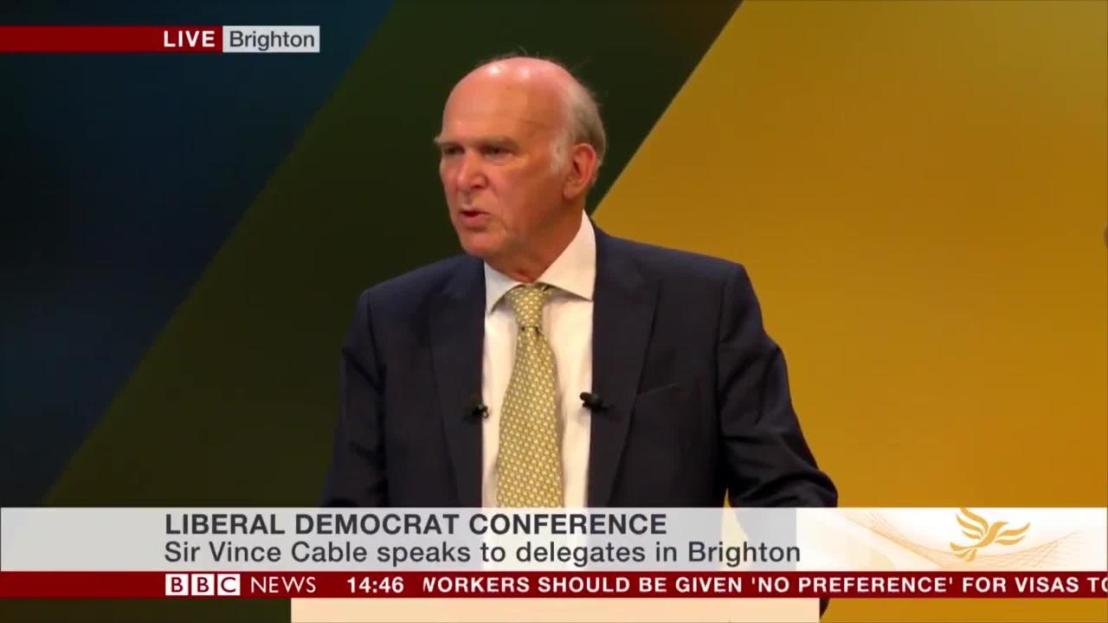
They have not just an ineffectual leader in Vince Cable but a weak leadership team who believe the only way to cut through is to be offensive in the press and be morally smug.
The Liberal Democrats ostensibly want to offer a home for the so-called “politically homeless” – Vince Cable likes to depict the Lib Dems as a rallying point for a movement of the moderates. As Isabel Hardman put it, unfortunately its sold with all the verve of a plug at a senior citizens’ community group for a new pilates club.
They talk of the ‘new politics’ and their capacity to be the fulcrum for a revitalised progressive consensus in this country, yet their playbook is entirely old school. It consists of Vince Cable and Jo Swinson angrily railing against the arrogance of politicians in other political parties and calling those who disagree with them morons or liars. It’s a very self-satisfied, complacent way of trying to widen support.
Indeed being smug to the point of labelling yourself as the party of “grown-ups” is hardly the best way to widen your appeal to potential switcher voters who feel politically homeless . It doesn’t come across as reasonable – it sounds puerile.
Moreover this is a leadership team that doesn’t want to lead its membership. There isn’t an attempt to challenge traditional Liberal Democrat membership hostility towards business, technology and the idea of more choice in public services. Nor are they making the running on housing supply and home ownership.
It feels to me that they are just a party happy to coast along, with its MPs displaying little hunger, and its leadership thinking the best way to convince people to vote for it is to say if we get seats and hold the balance of power we won’t go into government and moderate the actions of other parties but instead sit on the sidelines and wreck what we don’t like.
It isn’t a particularly enticing offer – it’s a pitch to support them to be concerned and angry but powerless on a bigger scale. While twitter may give politicians the impression that voters want politicians who can identify with their anger and their problems and speak for it, in reality most voters still want to back parties that can develop practical solutions and offer a clear vision and competent leadership. The Liberal Democrat pitch to stay on the sidelines for the next decade or more is a request for a perpetual sick note at a time of great national change.


 Daniel Cremin's Trove